An overview of common sensor types, monitoring locations, and the development trends of multi-parameter intelligent monitoring technologies in liquid cooling systems.
Sensors and Intelligent Monitoring Technologies in Liquid Cooling Systems
Why Liquid Cooling Systems Need Sensors
As computing density in AI data centers continues to increase, liquid cooling systems must handle increasingly large thermal loads. In addition to promptly removing heat generated by the equipment, systems need to maintain stable coolant temperature, pressure and flow rate over extended periods of operation, while also taking ambient temperature and humidity conditions around the equipment into account.
Compared with traditional air-cooling systems, liquid cooling systems contain more components, including pipes, pumps, valves, manifolds, cold plates and coolant distribution units (CDUs). Abnormal temperature, insufficient flow, abnormal pump unit vibration or coolant leak anywhere in the system can affect the normal operation and heat-removal capacity of the entire system and may even damage critical equipment such as servers.
Sensors are therefore an essential part of a liquid cooling system. By collecting operating data from different points in real time, operations and maintenance personnel can monitor system conditions, identify potential problems and obtain information to support subsequent maintenance and operational optimization.
Common Types of Sensors in Liquid Cooling Systems
In data center liquid cooling systems, different types of sensors and monitoring equipment collect different operating parameters. Common types of monitoring include the following:
- Temperature Sensors: Monitoring the Thermal Condition of the System
Temperature is an important parameter for evaluating the cooling performance of a liquid cooling system. Temperature sensors are commonly used to monitor coolant supply and return temperatures, and can also measure the operating temperatures of key components such as CPUs and GPUs.
Monitoring the supply-to-return coolant temperature differential (ΔT), together with coolant flow rate and other parameters, helps assess the heat removed by the coolant and provides a basis for evaluating system cooling performance.
- Pressure Sensors: Monitoring Pipeline Operating Conditions
Liquid cooling systems need to maintain stable operating pressure. Pressure sensors are mainly used to monitor pressure on the coolant supply and return sides, as well as pressure changes between different points along the piping.
Abnormal pressure fluctuations may indicate pump malfunction, pipeline blockage or a potential system leak. When considered together with other monitoring data, pressure readings can help operations and maintenance personnel further locate faults and determine their causes.
- Flow Sensors: Monitoring Coolant CirculationStatus
Flow sensors measure the flow rate of coolant through the piping, helping determine whether coolant is delivered to each piece of equipment in accordance with system design requirements.
Insufficient flow may leave servers without adequate cooling. Uneven flow distribution among branches may also cause localized overheating in some equipment. Monitoring both total flow and branch-level flow is therefore important for maintaining stable system operation.
- Vibration Sensors: Monitoring Pump Unit Operating Conditions
Pumps are essential for maintaining coolant circulation in liquid cooling systems. Vibration sensors can be used to collect vibration signals from pump units. Analyzing vibration amplitudes and frequency spectra can help identify potential faults such as rotor imbalance, bearing wear and misalignment.
Some integrated temperature and vibration sensors can also monitor equipment vibration and surface temperature simultaneously, supporting anomaly alerts, operating condition assessment and preventive maintenance.
- Humidity Sensors: Monitoring Ambient Humidity and Preventing Condensation Risks
Humidity sensors are primarily used to measure the relative humidity (RH) of the air in a data center or around equipment, and are generally used together with temperature sensors. In liquid cooling systems, temperature and humidity data can be used to calculate the ambient dew point.
When the coolant temperature is low, the surface temperature of pipes, fittings or cold plates may fall below the dew point of the surrounding air. Water vapor in the air may then condense on these surfaces. Monitoring ambient temperature and humidity, together with relevant surface-temperature data, makes it possible to assess condensation risks and provides a basis for adjusting the coolant supply temperature, improving pipe insulation or optimizing environmental control. It is important to note that humidity sensors monitor the air environment and cannot replace dedicated leak detection equipment.
- Leak Detection Sensors: Identifying Coolant Leak Risks in a Timely Manner
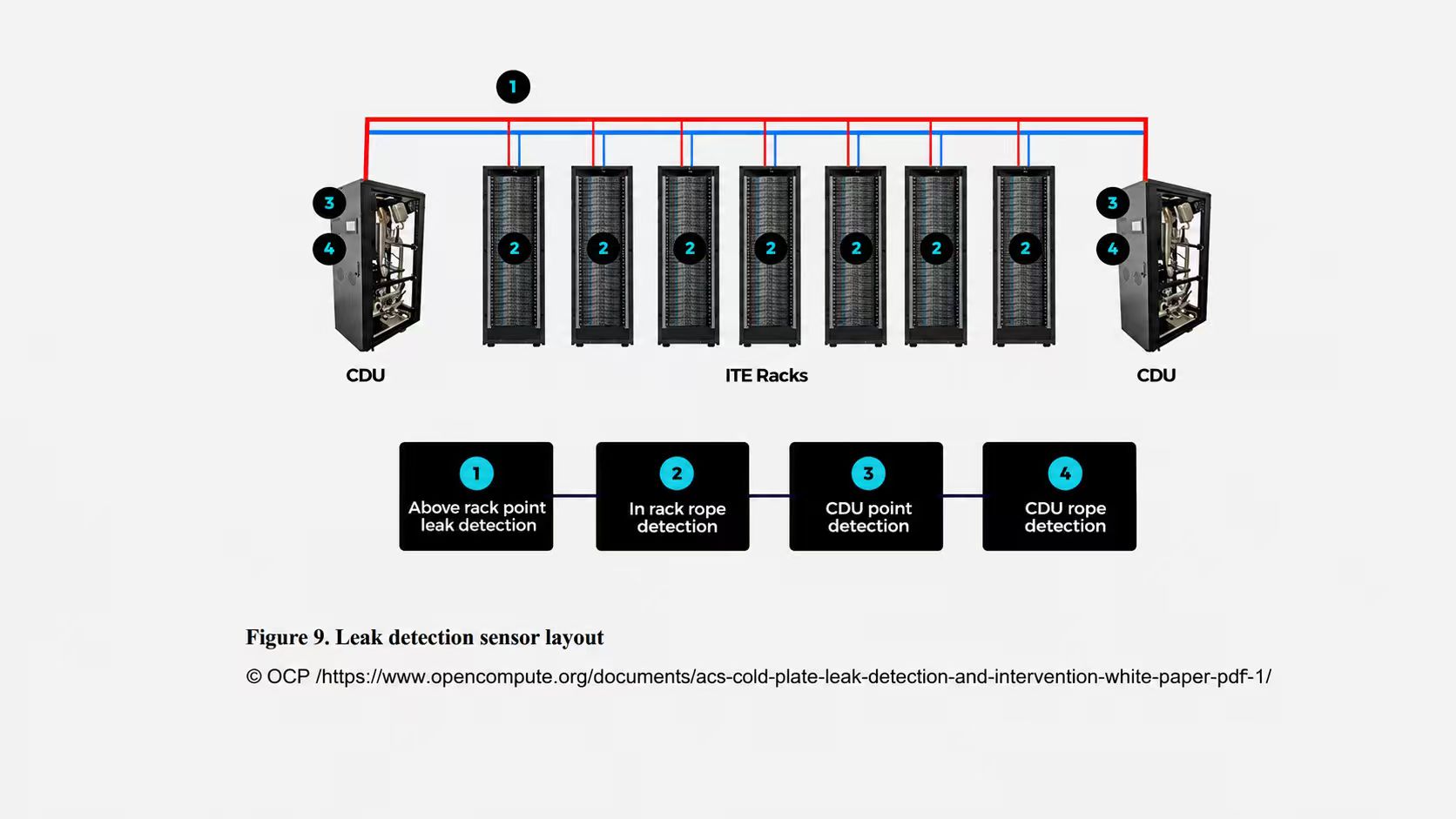
Coolant leakage is a key risk that liquid cooling systems need to address. Common detection methods include point leak sensors and leak detection cables.
These devices are generally installed at locations where coolant may accumulate, such as pipe connections, near quick disconnects and at the bottom of server racks. When coolant comes into contact with the sensing element, the system can trigger an alarm.
In addition to directly detecting the presence of liquid, potential leaks can also be identified indirectly through data such as pressure drops and abnormal flow rates. Combining these two approaches can help improve the timeliness of leak detection.
- Coolant Condition Monitoring: Assessing the Health of the Fluid
In addition to temperature, pressure and flow rate, the condition of the coolant itself also affects the long-term reliability of a liquid cooling system.
For example, pH indicates the acid-base condition of the coolant, while electrical conductivity can help identify changes in its chemical composition. The concentration of ethylene glycol or propylene glycol is related to the coolant's physical properties, while turbidity and particle content can help determine whether the fluid has been contaminated.
These parameters provide useful indications of coolant degradation, contamination or corrosion risks. Some can be monitored continuously using online instruments, while others require periodic sampling and testing.
Where Are Sensors Typically Installed?
Sensor locations directly affect monitoring effectiveness. A suitable layout needs to be designed according to the structure of the liquid cooling system, equipment operating conditions and potential risks.
In data center liquid cooling systems, common sensor installation locations include:
- CDU
Monitor supply and return temperatures, pressure, flow rate and pump operating status. The CDU is an important location for understanding the condition of the overall cooling loop.
- Pump Units and Areas Near Bearings and Housings
Install vibration sensors or integrated temperature and vibration sensors to monitor pump unit vibration and surface temperatures at key locations, helping identify abnormalities such as rotor imbalance, bearing wear and overheating.
- Manifolds
Monitor pressure and flow in different branches to ensure that coolant is distributed appropriately to each unit being cooled.
- Around Servers and Cold Plates
Monitor coolant inlet and outlet temperatures, as well as the temperatures of key components such as CPUs and GPUs, to identify localized cooling abnormalities in a timely manner.
- Pipe Connections and the Bottom of Server Racks
Install leak detection devices at locations requiring particular attention, including quick disconnects, pipe interfaces and areas where coolant may accumulate.
- Data Center Ambient Environment and Areas Near Low-Temperature Piping
Install temperature and humidity sensors to monitor the air in the data center or around server racks. Combined with the surface temperatures of pipes, fittings or cold plates, these measurements can be used to assess condensation risks.
Installing more sensors does not necessarily lead to better monitoring. Too many sensors increase system costs and maintenance complexity, while too few may prevent localized abnormalities from being detected in time. A suitable monitoring plan should therefore be determined according to actual operating conditions and risk levels.
Development Trends in Intelligent Monitoring Technologies
As liquid cooling systems continue to grow in scale and complexity, industry requirements for monitoring technologies are also changing. Monitoring is expanding beyond individual equipment parameters to provide a more comprehensive view of system operation and coolant condition.
This trend is also reflected in OCP's technical documents. For example, the OCP ACS Liquid Cooling Cold Plate Requirements Document sets out tiered minimum and advanced sensor requirements for liquid cooling systems. It also lists monitoring parameters at different levels, including the system level, chassis assembly level and CDU level, covering key indicators such as temperature, pressure and flow rate.
At the equipment-design level, Project Deschutes: Data Center Facilities 0.8.0 Specification, submitted by Google, illustrates the practical application of sensors and monitoring technologies in CDUs. The parameters covered include supply and return temperatures, pressure, flow rate, pump operating status, leak detection, coolant pH and electrical conductivity.
In addition, the 2026 OCP Global Summit's Cooling: Cold Plate session featured a presentation titled Fluid Monitoring: From Sensors to Insights. The presentation slides introduced the application of online monitoring, laboratory analysis and coordinated multi-parameter detection in coolant condition management.
Looking ahead, continued advances in sensor technologies and data analytics will make coordinated multi-parameter monitoring increasingly useful for anomaly alerts, troubleshooting and preventive maintenance in liquid cooling systems.
Partner with Huayuan Jinbo to Explore Liquid Cooling Innovation
As AI data centers continue to develop, sensors and intelligent monitoring technologies will play an increasingly important role in liquid cooling systems. From temperature, pressure, flow and pump unit vibration monitoring to ambient temperature and humidity monitoring, condensation risk management, coolant condition management and leak detection, reliable sensing technologies provide an essential foundation for long-term system stability.
Huayuan Jinbo specializes in sensors, printed circuit boards and printed circuit board assemblies (PCB/PCBA), metal bellows and related products. We are committed to applying our accumulated technical expertise to the liquid cooling field and providing reliable products and solutions for the industry.
To learn more about Huayuan Jinbo's sensor and measurement solutions and related products, please visit our Sensors & Measurement Solutions page. For product selection, application evaluation or technical collaboration, please contact us through our inquiry page.
Industry partners interested in participating in liquid cooling innovation and industry collaboration are also welcome to learn about and join our Liquid Cooling & Intelligent Sensing Ecosystem, and work with us to advance the development and application of liquid cooling technologies.